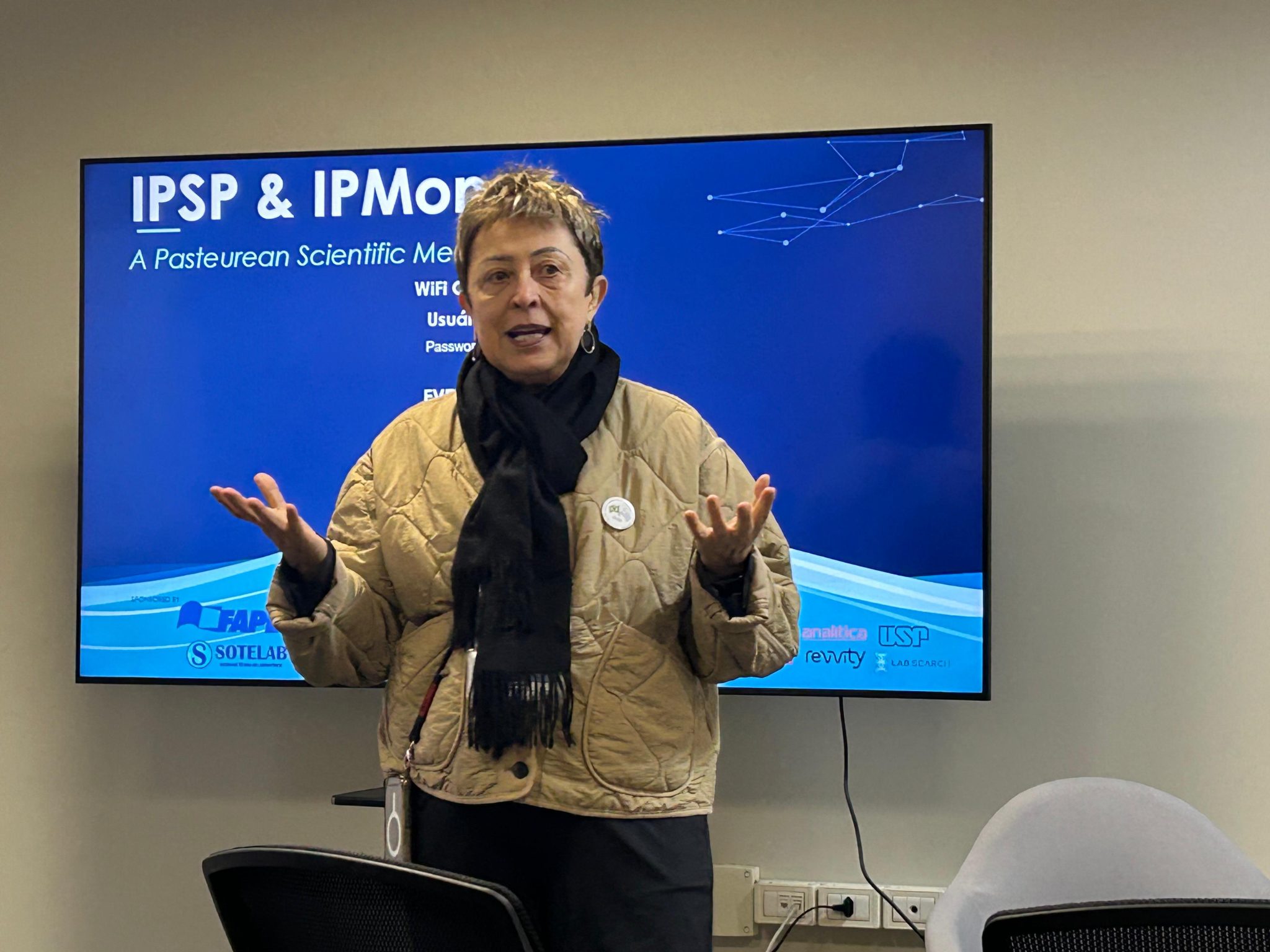
The scientific collaboration between the Institut Pasteur de São Paulo (IPSP) and the Institut Pasteur de Montevideo (IP Montevideo) marked the opening of the IP São Paulo & IP Montevideo – A Pasteurean Scientific Meeting, which began on September 16 at the University of São Paulo. The meeting was conceived to expand cooperation between the two institutes, identify complementary capabilities, and promote the development of joint projects.
During the opening session, IPSP Executive Director Paola Minoprio reflected on the history connecting the two institutions. In the early 2000s, she was involved in the creation of the Institut Pasteur de Montevideo and recalled that this experience had a direct influence on her subsequent career in Brazil, where she worked to help establish the Institut Pasteur de São Paulo.
According to Minoprio, despite their geographic proximity and shared scientific interests, the two institutes still knew relatively little about each other’s work. The meeting was conceived precisely to bridge this gap and generate concrete opportunities for collaboration. She also highlighted the support of FAPESP, which maintains a cooperation agreement with the Institut Pasteur de Montevideo aimed, among other objectives, at bringing researchers together and developing joint projects, promoting student mobility, and contributing to the training of young scientists.
The expectation, she said, is for this to be the first in a series of meetings between the two institutions. Minoprio also highlighted the decision to directly involve younger researchers in the scientific organization of the event, with the aim of enabling new collaboration networks to take shape among this generation.
Next, Yannick Samson, Cooperation and Cultural Action Attaché at the Consulate General of France in São Paulo, placed the meeting within the broader context of science diplomacy. In his view, science has a role that extends beyond knowledge production: it can serve as a tool for cooperation and for building bridges between countries and institutions.
Samson highlighted values associated with international scientific cooperation, such as academic freedom, scientific integrity, and reciprocity, and connected the meeting to the One Health approach, which is based on integrating human, animal, and environmental health. He also emphasized the role of the Institut Pasteur de São Paulo in scientific cooperation between France and Brazil and noted that closer ties with Montevideo expand this collaboration into a regional dimension involving France, Brazil, and Uruguay.
The institutional presentation of the Institut Pasteur de Montevideo was given by researcher Marcelo Comini – Head of the Laboratory of Redox Biology of Trypanosomes– , who emphasized that the Uruguayan delegation had not come to São Paulo solely to present scientific results, but primarily to identify common interests and opportunities for complementary technological development.
Comini presented an overview of IP Montevideo’s scientific activities and explained that its consolidation resulted from different strategies for training researchers, establishing institutional programs, developing technological platforms, and promoting innovation.
